Update
Discover what's new in the
version 2.1
Alternative to Humind for
e-commerce AI chatbot: what to choose?
Alternative to Humind for e-commerce AI chatbot: what to choose?
Are you looking for an alternative to Humind to support your visitors, answer their product questions, or increase your conversions on Shopify? Humind AI has established itself as a conversational AI salesperson on Shopify, with a clear promise: to guide each customer to the right product through natural interactions. It is a well-rated French solution that focuses on AI-driven shopping assistance.
But if your priority is not managing conversation quotas and product learning limits, but rather deploying a complete, native Shopify e-commerce AI chatbot with no chat limits, Humind can quickly become expensive. The Starter and Growth plans only learn 200 products, branding can only be removed at $680/month, and every conversation overage generates extra costs.
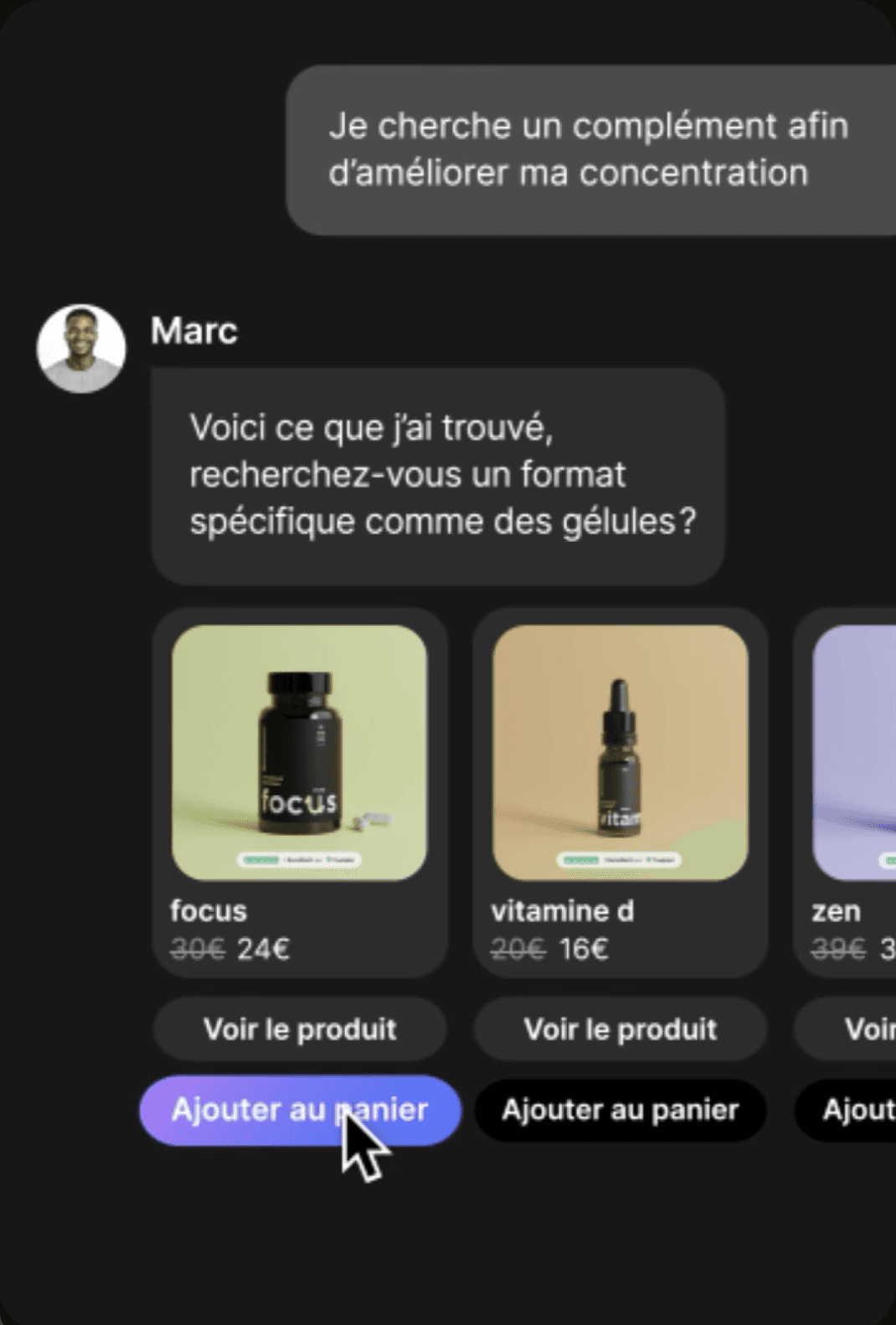
Qstomy addresses this angle: a native Shopify e-commerce AI chatbot (Built for Shopify) that combines automated support, product recommendations, AI pop-ups, promo codes, and conversion analytics. Where Humind bills per conversation and limits catalog learning, Qstomy offers unlimited AI chats and product synchronization with no announced cap.
Are you looking for an alternative to Humind to support your visitors, answer their product questions, or increase your conversions on Shopify? Humind AI has established itself as a conversational AI salesperson on Shopify, with a clear promise: to guide each customer to the right product through natural interactions. It is a well-rated French solution that focuses on AI-driven shopping assistance.
But if your priority is not managing conversation quotas and product learning limits, but rather deploying a complete, native Shopify e-commerce AI chatbot with no chat limits, Humind can quickly become expensive. The Starter and Growth plans only learn 200 products, branding can only be removed at $680/month, and every conversation overage generates extra costs.
Qstomy addresses this angle: a native Shopify e-commerce AI chatbot (Built for Shopify) that combines automated support, product recommendations, AI pop-ups, promo codes, and conversion analytics. Where Humind bills per conversation and limits catalog learning, Qstomy offers unlimited AI chats and product synchronization with no announced cap.

Built for Shopify

All personal data
are protected and secure
Humind and Qstomy do not address the same problem
Humind and Qstomy do not address the same problem
The core difference is not sales vs support: both solutions aim for conversion on Shopify. Rather, its a question of business model, catalog limits, and functional scope.
Humind is a conversational AI salesperson billed by conversations (200 to 6,000/month) with product learning caps (200 products on Starter and Growth, 20,000 on Pro). The starting price is $49/month, with additional costs for each conversation tier exceeded.
Qstomy is a unified Shopify e-commerce AI chatbot: automated support (orders, shipping, returns, FAQ) and sales (recommendations, AI pop-ups, promo codes) in a single offer. Unlimited AI chats, no announced catalog limit, variable billing based on Shopify-attributed AI orders. For a VSE, a Shopify SME, or a founder who wants AI without multiplying quotas, this simplicity is a game changer.
The core difference is not sales vs support: both solutions aim for conversion on Shopify. Rather, its a question of business model, catalog limits, and functional scope.
Humind is a conversational AI salesperson billed by conversations (200 to 6,000/month) with product learning caps (200 products on Starter and Growth, 20,000 on Pro). The starting price is $49/month, with additional costs for each conversation tier exceeded.
Qstomy is a unified Shopify e-commerce AI chatbot: automated support (orders, shipping, returns, FAQ) and sales (recommendations, AI pop-ups, promo codes) in a single offer. Unlimited AI chats, no announced catalog limit, variable billing based on Shopify-attributed AI orders. For a VSE, a Shopify SME, or a founder who wants AI without multiplying quotas, this simplicity is a game changer.
Humind
ostomy
Main problem addressed
Sell through a conversational AI assistant (ChatGPT Shopping)
Convert and automate e-commerce conversations on Shopify
Product logic
AI Seller + widgets + order tracking + analytics
Native Shopify e-commerce AI Chatbot (Built for Shopify)
Primary user
Shopify merchant looking for an online AI advisor IA
Shopify merchant, founder, e-commerce or growth manager
Business objective
Guide visitors to purchase through AI conversation
Increase conversions while automating on-site support
Humind
Sell through a conversational AI assistant (ChatGPT Shopping)
Product logic
Humind
AI Seller + widgets + order tracking + analytics
ostomy
Native Shopify e-commerce AI Chatbot (Built for Shopify)
Primary user
ostomy
Shopify merchant, founder, e-commerce or growth manager
Humind
Shopify merchant looking for an online AI advisor IA
Business objective
ostomy
Increase conversions while automating on-site support
ostomy
Convert and automate e-commerce conversations on Shopify
Main problem addressed
Humind
Guide visitors to purchase through AI conversation
Why look for an alternative to Humind for Shopify?
Why look for an alternative to Humind for Shopify?
Humind can be excellent for a Shopify store with a limited catalog and a controlled volume of conversations. However, many merchants look for an alternative when they realize that the caps on conversations and products slow down their growth or that the total cost exceeds their budget.
Conversation-based pricing model: Humind plans include a monthly quota (200 to 6,000). Beyond that, additional fees apply ($12 to $25 per bracket depending on the plan).
Product training limits: Starter and Growth only learn 200 products each (App Store listing, June 2026). For a larger catalog, you must upgrade to the Pro plan ($299/month, 20,000 products) or Enterprise ($680/month).
Humind Branding: removing the branding is only available on the Enterprise plan at $680/month.
Pro / Enterprise price jump: moving from $99/month (Growth) to $299/month (Pro) or $680/month (Enterprise) represents a significant investment for an SMB.
Limited customer service support: Humind covers order tracking, but merchants who want an agent that unifies sales, delivery/return FAQs, pop-ups, and native Shopify promo codes often look for a more comprehensive alternative.
Variable cost during high-traffic periods: sales, holidays, or advertising campaigns can blow up the bill with extra conversation charges.
Feature / price ratio comparison: for an equivalent volume, the monthly cost and additional charges are worth comparing to other Shopify AI assistants.
If your priority is to convert more visitors into customers without conversation caps, a sales solution with an AI chatbot like Qstomy might be better aligned. Also, check out our guide on why use an AI chatbot for e-commerce, the article e-commerce chatbot: save time and money, and our resource on e-commerce customer service automation.
Humind can be excellent for a Shopify store with a limited catalog and a controlled volume of conversations. However, many merchants look for an alternative when they realize that the caps on conversations and products slow down their growth or that the total cost exceeds their budget.
Conversation-based pricing model: Humind plans include a monthly quota (200 to 6,000). Beyond that, additional fees apply ($12 to $25 per bracket depending on the plan).
Product training limits: Starter and Growth only learn 200 products each (App Store listing, June 2026). For a larger catalog, you must upgrade to the Pro plan ($299/month, 20,000 products) or Enterprise ($680/month).
Humind Branding: removing the branding is only available on the Enterprise plan at $680/month.
Pro / Enterprise price jump: moving from $99/month (Growth) to $299/month (Pro) or $680/month (Enterprise) represents a significant investment for an SMB.
Limited customer service support: Humind covers order tracking, but merchants who want an agent that unifies sales, delivery/return FAQs, pop-ups, and native Shopify promo codes often look for a more comprehensive alternative.
Variable cost during high-traffic periods: sales, holidays, or advertising campaigns can blow up the bill with extra conversation charges.
Feature / price ratio comparison: for an equivalent volume, the monthly cost and additional charges are worth comparing to other Shopify AI assistants.
If your priority is to convert more visitors into customers without conversation caps, a sales solution with an AI chatbot like Qstomy might be better aligned. Also, check out our guide on why use an AI chatbot for e-commerce, the article e-commerce chatbot: save time and money, and our resource on e-commerce customer service automation.
Why Qstomy is a real alternative to Humind for e-commerce
Why Qstomy is a real alternative to Humind for e-commerce
Qstomy does not try to reproduce every brick of Humind (weekly email reports, Gorgias integration, A/B test compatibility). The value proposition is more targeted: to give Shopify stores an e-commerce AI agent capable of selling, advising, answering, and measuring its impact, with no chat cap or announced catalog limit.
Qstomy does not try to reproduce every brick of Humind (weekly email reports, Gorgias integration, A/B test compatibility). The value proposition is more targeted: to give Shopify stores an e-commerce AI agent capable of selling, advising, answering, and measuring its impact, with no chat cap or announced catalog limit.
Unlimited AI chats vs conversation quotas
Humind caps conversations at 200 (Starter), 500 (Growth), 2,000 (Pro) or 6,000 (Enterprise) per month, with extra charges for any overage. Qstomy offers unlimited AI chats according to its pricing page, with variable billing on AI orders attributed by Shopify (300 included, then €30 per additional block of 300 orders).
For a store with many exploratory conversations (product questions, comparisons, hesitations), the Humind model can cost more than a model aligned with generated sales. Qstomy is suitable for merchants who want to let the AI converse freely without counting every exchange.
Humind caps conversations at 200 (Starter), 500 (Growth), 2,000 (Pro) or 6,000 (Enterprise) per month, with extra charges for any overage. Qstomy offers unlimited AI chats according to its pricing page, with variable billing on AI orders attributed by Shopify (300 included, then €30 per additional block of 300 orders).
For a store with many exploratory conversations (product questions, comparisons, hesitations), the Humind model can cost more than a model aligned with generated sales. Qstomy is suitable for merchants who want to let the AI converse freely without counting every exchange.
Unlimited catalog vs 200 products on entry-level plans
On Humind, the Starter and Growth plans only learn 200 products each. For a catalog of 500, 1,000, or several thousand references, you need to upgrade to the Pro plan ($299/month) or Enterprise ($680/month). Qstomy announces unlimited catalog synchronization, with the possibility of enriching the AI via URLs and documents (T&Cs, guides, FAQ).
On Humind, the Starter and Growth plans only learn 200 products each. For a catalog of 500, 1,000, or several thousand references, you need to upgrade to the Pro plan ($299/month) or Enterprise ($680/month). Qstomy announces unlimited catalog synchronization, with the possibility of enriching the AI via URLs and documents (T&Cs, guides, FAQ).
A conversion-oriented Shopify integration
Qstomy is designed for Shopify and its merchant operations: catalog, orders, discount codes, recommendations, and attribution. The Qstomy Shopify integration page details this native alignment, in the spirit of Built for Shopify best practices.
Humind excels at AI widgets and Gorgias integration. Qstomy, on the other hand, anchors AI pop-ups, native Shopify discount codes, and conversion analytics directly into the merchant ecosystem, with CS automation via the automated customer support page. To see where these tools fit, see also Shopify integrations.
Qstomy is designed for Shopify and its merchant operations: catalog, orders, discount codes, recommendations, and attribution. The Qstomy Shopify integration page details this native alignment, in the spirit of Built for Shopify best practices.
Humind excels at AI widgets and Gorgias integration. Qstomy, on the other hand, anchors AI pop-ups, native Shopify discount codes, and conversion analytics directly into the merchant ecosystem, with CS automation via the automated customer support page. To see where these tools fit, see also Shopify integrations.
Support + sales in a single agent, at an affordable price
Humind starts at $49/month with 200 conversations and 200 products. Qstomy offers a free plan depending on the current promotion, then €29.99/month with unlimited chats and 300 AI orders included. For a VSE or SME, the cost/value ratio is worth comparing based on your actual volumes.
Humind starts at $49/month with 200 conversations and 200 products. Qstomy offers a free plan depending on the current promotion, then €29.99/month with unlimited chats and 300 AI orders included. For a VSE or SME, the cost/value ratio is worth comparing based on your actual volumes.
Price: Humind vs Qstomy
Humind's pricing is displayed on the Shopify App Store. They are billed in US dollars (USD), renewing every 30 days. A 14-day free trial is offered on each plan. Charges may be billed separately from your standard Shopify invoice.
Humind's pricing is displayed on the Shopify App Store. They are billed in US dollars (USD), renewing every 30 days. A 14-day free trial is offered on each plan. Charges may be billed separately from your standard Shopify invoice.
Offer
Retail price
Notable points
Starter
$49
AI widgets, order tracking, basic analytics.
Growth
$99 (or $1,011/yr, -15%)
All features, advanced AI analytics.
Pro
$299 (or $2,870/year, -20%)
Dedicated premium support.
Enterprise
$680 (or $6,120/yr, -25%)
Removal of Humind branding.
Elements not to be overlooked in the Humind calculation
The conversation quota: during peak periods, additional costs accumulate quickly.
The catalog size: Starter and Growth cap at 200 products; a larger catalog requires the Pro or Enterprise plan.
Branding: removing the Humind mention requires the Enterprise plan at $680/month.
The currency: billing is in USD, to be converted according to your accounting.
No permanent free plan: 14-day trial only; first paid plan at $49/month (App Store).
Annual billing: available on Growth (-15%), Pro (-20%) and Enterprise (-25%); Starter is monthly only.
Usage-based charges: additional conversation costs + possible external fees outside the Shopify invoice (App Store).
Elements not to be overlooked in the Humind calculation
The conversation quota: during peak periods, additional costs accumulate quickly.
The catalog size: Starter and Growth cap at 200 products; a larger catalog requires the Pro or Enterprise plan.
Branding: removing the Humind mention requires the Enterprise plan at $680/month.
The currency: billing is in USD, to be converted according to your accounting.
No permanent free plan: 14-day trial only; first paid plan at $49/month (App Store).
Annual billing: available on Growth (-15%), Pro (-20%) and Enterprise (-25%); Starter is monthly only.
Usage-based charges: additional conversation costs + possible external fees outside the Shopify invoice (App Store).
Comparison: iAdvize vs Qstomy
Comparison: iAdvize vs Qstomy
Criterion
Humind
Ostomy
Positioning
Conversational AI Salesperson for Shopify (ChatGPT Shopping)
E-commerce AI Agent: support, sales, recommendations, and analytics
Target audience
Shopify stores looking for an online AI advisor AI
E-commerce merchants (Shopify priority) wanting to automate support and conversion
Platform
Exclusive Shopify application
Shopify app (Built for Shopify)
AI conversations / chats
Monthly quota per plan (200 to 6,000) + overage charge beyond
Unlimited AI chats
Catalog learning
200 products (Starter/Growth), 20,000 (Pro), unlimited (Enterprise)
No announced limit (auto-sync + URLs and documents)
Product recommendations
Yes (AI, cross-selling, upselling, bundles)
Yes (AI recommendations and cross-selling, see AI chatbot selling)
What to choose? iAdvize vs Qstomy
What to choose? iAdvize vs Qstomy
Humind remains a relevant choice in several contexts:
You are on Shopify and looking for a "turnkey" AI salesperson: the advertised 5-minute installation and conversational positioning align with this need.
You already use Gorgias: the native integration mentioned on the App Store can simplify the coexistence of helpdesk and AI assistant.
Your catalog has fewer than 200 products: on Starter or Growth, the learning limits may be sufficient.
You value weekly email reports: the automatic summary of interactions can suit a team that prefers regular digests.
You are testing AI widgets with A/B testing: Humind highlights compatibility with existing testing tools.
You appreciate a French-speaking contact: the publisher is based in France and public reviews highlight the team's responsiveness.
Your volume stays under 200 to 500 conversations/month: the Starter or Growth plan may be sufficient without extra costs.
Qstomy is a more suitable alternative when your priority is an accessible e-commerce AI chatbot, with no conversation caps or catalog limits on entry-level plans.
You want AI chats with no conversation caps: according to the pricing page, Qstomy offers unlimited chats, which reassures stores with high or seasonal traffic.
Your catalog exceeds 200 products: the announced absence of learning limits prevents having to immediately upgrade to Pro ($299) or Enterprise ($680).
You want to combine sales and support in a single agent: Qstomy covers recommendations, sales pop-ups, native Shopify promo codes, and support (orders, FAQ, delivery, returns).
E-commerce analytics are a decisive criterion: the dashboard focused on conversion, average order value, and recommendations via data & analytics.
You want to enrich the AI beyond the catalog: possibility to add URLs and documents to the learning process (T&Cs, guides, external FAQs).
Your starting budget is tight: free plan then €29.99/month vs a minimum of $49/month for Humind, with different limits to compare against your actual volumes.
You want to customize the branding without paying $680/month: customization (logo, tone of voice) is integrated into the Qstomy offer.
For a Shopify store that wants to leverage AI for growth without quotas or catalog caps, Qstomy is a more targeted alternative. Humind helps you sell through conversation; Qstomy helps you sell better and respond faster, while improving the e-commerce customer experience throughout the buying journey.
Humind remains a relevant choice in several contexts:
You are on Shopify and looking for a "turnkey" AI salesperson: the advertised 5-minute installation and conversational positioning align with this need.
You already use Gorgias: the native integration mentioned on the App Store can simplify the coexistence of helpdesk and AI assistant.
Your catalog has fewer than 200 products: on Starter or Growth, the learning limits may be sufficient.
You value weekly email reports: the automatic summary of interactions can suit a team that prefers regular digests.
You are testing AI widgets with A/B testing: Humind highlights compatibility with existing testing tools.
You appreciate a French-speaking contact: the publisher is based in France and public reviews highlight the team's responsiveness.
Your volume stays under 200 to 500 conversations/month: the Starter or Growth plan may be sufficient without extra costs.
Qstomy is a more suitable alternative when your priority is an accessible e-commerce AI chatbot, with no conversation caps or catalog limits on entry-level plans.
You want AI chats with no conversation caps: according to the pricing page, Qstomy offers unlimited chats, which reassures stores with high or seasonal traffic.
Your catalog exceeds 200 products: the announced absence of learning limits prevents having to immediately upgrade to Pro ($299) or Enterprise ($680).
You want to combine sales and support in a single agent: Qstomy covers recommendations, sales pop-ups, native Shopify promo codes, and support (orders, FAQ, delivery, returns).
E-commerce analytics are a decisive criterion: the dashboard focused on conversion, average order value, and recommendations via data & analytics.
You want to enrich the AI beyond the catalog: possibility to add URLs and documents to the learning process (T&Cs, guides, external FAQs).
Your starting budget is tight: free plan then €29.99/month vs a minimum of $49/month for Humind, with different limits to compare against your actual volumes.
You want to customize the branding without paying $680/month: customization (logo, tone of voice) is integrated into the Qstomy offer.
For a Shopify store that wants to leverage AI for growth without quotas or catalog caps, Qstomy is a more targeted alternative. Humind helps you sell through conversation; Qstomy helps you sell better and respond faster, while improving the e-commerce customer experience throughout the buying journey.
Decision matrix
Decision matrix
Your priority
Preferred solution
Gorgias integration + A/B testable widgets
Humind
Weekly email reports
Humind
Catalog < 200 products and < 500 conversations/month
Humind
Unlimited AI chats with no monthly quota
ostomy
Catalog > 200 products without immediate upgrade
ostomy
Automated customer support (delivery, returns, FAQ)
ostomy
AI pop-ups and native Shopify promo codes
ostomy
Monthly budget under $50 with AI included
ostomy
To go further
To go further
If you are comparing Humind and Qstomy, these resources might support your thinking.
Automation and support: what is e-commerce automation?, succeeding with e-commerce automation, e-commerce returns management, causes and reduction of return rates, inbound customer service, exceptional customer experience in e-commerce.
Conversion and loyalty: increasing traffic and conversion, customer loyalty and life value, why optimize the conversion rate, building an e-commerce conversion funnel, how to improve the e-commerce conversion rate, increasing online sales.
Shopify and analytics: how Shopify works, why choose Shopify for e-commerce, Shopify analytics to drive growth, e-commerce analytics metrics to track, how analytics serve e-commerce, calculating and increasing the average order value.
AI and recommendations: e-commerce CRO: transforming traffic into sales, 2026 conversion rate benchmarks, optimizing a product page for conversion, boosting sales with smart recommendations, Shopify conversion rate.
Qstomy Product: selling with an AI chatbot, customer support, e-commerce analytics, Qstomy pricing, Qstomy demo.
If you are comparing Humind and Qstomy, these resources might support your thinking.
Automation and support: what is e-commerce automation?, succeeding with e-commerce automation, e-commerce returns management, causes and reduction of return rates, inbound customer service, exceptional customer experience in e-commerce.
Conversion and loyalty: increasing traffic and conversion, customer loyalty and life value, why optimize the conversion rate, building an e-commerce conversion funnel, how to improve the e-commerce conversion rate, increasing online sales.
Shopify and analytics: how Shopify works, why choose Shopify for e-commerce, Shopify analytics to drive growth, e-commerce analytics metrics to track, how analytics serve e-commerce, calculating and increasing the average order value.
AI and recommendations: e-commerce CRO: transforming traffic into sales, 2026 conversion rate benchmarks, optimizing a product page for conversion, boosting sales with smart recommendations, Shopify conversion rate.
Qstomy Product: selling with an AI chatbot, customer support, e-commerce analytics, Qstomy pricing, Qstomy demo.
What is Humind?
What is Humind?
Humind is a Shopify application marketed under the name Humind AI - ChatGPT Shopping. Developed by a team based in Saint-Ouen-sur-Seine (74 boulevard Victor Hugo, 93400, France) and launched on the Shopify App Store on February 5, 2025, it positions itself as an AI salesperson: an assistant capable of engaging visitors in conversation, understanding their needs, and offering personalized product recommendations.
Unlike a generalist helpdesk or a simple FAQ widget, Humind focuses on purchasing assistance and conversion. The tool relies on advanced language models (including GPT 5, according to the App Store listing) and offers embeddable AI widgets for the store. It targets Shopify e-merchants who want to replicate the experience of an in-store advisor online: asking questions, resolving doubts, and guiding toward a purchase.
Humind is available exclusively through the Shopify App Store. It is not an independent multi-channel solution separate from Shopify, but rather a native application designed for stores hosted on this platform.
Key Features
Real-time AI conversations: chat widget to engage visitors and answer their questions.
AI-based product recommendations: personalized suggestions, cross-selling, upselling, bundles.
AI Widgets: interactive elements designed to overcome hesitation and improve conversion rates (A/B test compatibility mentioned).
24/7 automated order tracking: answers to order-related questions without human intervention.
Automated responses and personalization: adaptation to the brand's voice.
Analytics: basic analytics on the Starter plan, advanced AI analytics from the Growth plan onwards.
Weekly email reports: summary of customer interactions sent every week.
Translation and multilingual support: French, English, German, Spanish, Arabic, Hebrew, Italian, Dutch, Portuguese, Simplified and Traditional Chinese, etc.
Integrations
Humind indicates integrations with ChatGPT, Gemini, GPT 5, Shopify checkout, and Gorgias. This latter integration may interest stores that already combine a Gorgias helpdesk with a storefront AI assistant.
Public reviews on the Shopify App Store (rating of 5.0 out of 7 reviews in June 2026) highlight the ease of integration, the relevance of the responses, and the support from the Humind team (based in France). These reviews remain limited in volume; they do not guarantee the same results for all stores.
Humind is a Shopify application marketed under the name Humind AI - ChatGPT Shopping. Developed by a team based in Saint-Ouen-sur-Seine (74 boulevard Victor Hugo, 93400, France) and launched on the Shopify App Store on February 5, 2025, it positions itself as an AI salesperson: an assistant capable of engaging visitors in conversation, understanding their needs, and offering personalized product recommendations.
Unlike a generalist helpdesk or a simple FAQ widget, Humind focuses on purchasing assistance and conversion. The tool relies on advanced language models (including GPT 5, according to the App Store listing) and offers embeddable AI widgets for the store. It targets Shopify e-merchants who want to replicate the experience of an in-store advisor online: asking questions, resolving doubts, and guiding toward a purchase.
Humind is available exclusively through the Shopify App Store. It is not an independent multi-channel solution separate from Shopify, but rather a native application designed for stores hosted on this platform.
Key Features
Real-time AI conversations: chat widget to engage visitors and answer their questions.
AI-based product recommendations: personalized suggestions, cross-selling, upselling, bundles.
AI Widgets: interactive elements designed to overcome hesitation and improve conversion rates (A/B test compatibility mentioned).
24/7 automated order tracking: answers to order-related questions without human intervention.
Automated responses and personalization: adaptation to the brand's voice.
Analytics: basic analytics on the Starter plan, advanced AI analytics from the Growth plan onwards.
Weekly email reports: summary of customer interactions sent every week.
Translation and multilingual support: French, English, German, Spanish, Arabic, Hebrew, Italian, Dutch, Portuguese, Simplified and Traditional Chinese, etc.
Integrations
Humind indicates integrations with ChatGPT, Gemini, GPT 5, Shopify checkout, and Gorgias. This latter integration may interest stores that already combine a Gorgias helpdesk with a storefront AI assistant.
Public reviews on the Shopify App Store (rating of 5.0 out of 7 reviews in June 2026) highlight the ease of integration, the relevance of the responses, and the support from the Humind team (based in France). These reviews remain limited in volume; they do not guarantee the same results for all stores.
FAQ on alternatives to Humind
FAQ on alternatives to Humind
What is the best alternative to Humind for Shopify?
For a Shopify store looking for an affordable sales- and support-oriented AI chatbot, with unlimited chats and an unannounced catalog limit, Qstomy is a relevant alternative. Humind remains more suitable if you have fewer than 200 products, use Gorgias, value weekly email reports, or are A/B testing widgets. Compare at least two solutions on your own metrics.
Why look for an alternative to Humind?
The most common reasons are exceeding the conversation quota, product training limits (200 products on Starter and Growth), the cost of the Enterprise plan to remove branding ($680/month), or the need for a wider scope (customer support, pop-ups, promo codes). Looking for an alternative often reflects an evolution of your store, not a rejection of Humind's quality.
Is Humind suitable for Shopify?
Yes. Humind is a native Shopify App Store application, designed exclusively for Shopify stores (launched on February 5, 2025). It accesses the online store's products, orders, and pages according to the permissions described in the App Store.
Can Qstomy replace Humind?
Qstomy can replace Humind if your strategy relies on an AI agent combining customer support, product recommendations, sales pop-ups, and e-commerce analytics, with no cap on conversations. However, if Gorgias integration, weekly email reports, or Humind A/B test compatibility are essential to your workflow, verify that your stack can adapt.
How much does Humind cost compared to Qstomy?
Based on public pricing in June 2026, Humind starts at $49/month (200 conversations, 200 products) with a 14-day trial. Qstomy offers a free plan according to its pricing page, then €29.99/month with 300 included AI orders and unlimited chats. Direct comparison is tricky because the units differ (conversations vs. AI orders). Calculate the projected cost based on your actual traffic.
Humind or Qstomy for a Shopify micro-business?
For a micro-business with a limited budget, a growing catalog, and a need to cover sales + support, Qstomy is worth evaluating first due to its accessible pricing and unlimited chats. Humind remains relevant if you have fewer than 200 products, a modest volume of conversations, and AI widgets with Gorgias integration are confirmed priorities.
Is Qstomy suitable for stores with a large catalog?
Yes. This is one of the most natural use cases for an alternative to Humind. Humind's Starter and Growth plans cap at 200 products; Qstomy advertises unlimited catalog synchronization, avoiding an immediate upgrade to Pro ($299) or Enterprise ($680). This is often the ideal profile for a brand looking to increase its online sales without catalog constraints.
Want to test a more accessible, e-commerce-focused alternative to Humind? Discover the Shopify Qstomy integration, view Qstomy offers, or book a demo to see how an AI sales chatbot can support your visitors.
What is the best alternative to Humind for Shopify?
For a Shopify store looking for an affordable sales- and support-oriented AI chatbot, with unlimited chats and an unannounced catalog limit, Qstomy is a relevant alternative. Humind remains more suitable if you have fewer than 200 products, use Gorgias, value weekly email reports, or are A/B testing widgets. Compare at least two solutions on your own metrics.
Why look for an alternative to Humind?
The most common reasons are exceeding the conversation quota, product training limits (200 products on Starter and Growth), the cost of the Enterprise plan to remove branding ($680/month), or the need for a wider scope (customer support, pop-ups, promo codes). Looking for an alternative often reflects an evolution of your store, not a rejection of Humind's quality.
Is Humind suitable for Shopify?
Yes. Humind is a native Shopify App Store application, designed exclusively for Shopify stores (launched on February 5, 2025). It accesses the online store's products, orders, and pages according to the permissions described in the App Store.
Can Qstomy replace Humind?
Qstomy can replace Humind if your strategy relies on an AI agent combining customer support, product recommendations, sales pop-ups, and e-commerce analytics, with no cap on conversations. However, if Gorgias integration, weekly email reports, or Humind A/B test compatibility are essential to your workflow, verify that your stack can adapt.
How much does Humind cost compared to Qstomy?
Based on public pricing in June 2026, Humind starts at $49/month (200 conversations, 200 products) with a 14-day trial. Qstomy offers a free plan according to its pricing page, then €29.99/month with 300 included AI orders and unlimited chats. Direct comparison is tricky because the units differ (conversations vs. AI orders). Calculate the projected cost based on your actual traffic.
Humind or Qstomy for a Shopify micro-business?
For a micro-business with a limited budget, a growing catalog, and a need to cover sales + support, Qstomy is worth evaluating first due to its accessible pricing and unlimited chats. Humind remains relevant if you have fewer than 200 products, a modest volume of conversations, and AI widgets with Gorgias integration are confirmed priorities.
Is Qstomy suitable for stores with a large catalog?
Yes. This is one of the most natural use cases for an alternative to Humind. Humind's Starter and Growth plans cap at 200 products; Qstomy advertises unlimited catalog synchronization, avoiding an immediate upgrade to Pro ($299) or Enterprise ($680). This is often the ideal profile for a brand looking to increase its online sales without catalog constraints.
Want to test a more accessible, e-commerce-focused alternative to Humind? Discover the Shopify Qstomy integration, view Qstomy offers, or book a demo to see how an AI sales chatbot can support your visitors.
Qstomy, a credible and affordable alternative to market leaders
Qstomy, a credible and affordable alternative to market leaders

Alternative to Zipchat

Alternative to iAdvize

Alternative to Tidio

Alternative to Zendesk

Alternative to Gorgias

Alternative to Intercom

Alternative to Shopify Inbox

Alternative to Chatty

Alternative to Crisp

Alternative to Re:amaze

Alternative to Richpanel

Alternative to Dialog

Alternative to Convi

Alternative to Rep AI
Frequently asked questions before installing Qstomy
Frequently asked questions before installing Qstomy
Here are the questions that e-commerce merchants ask us most often before booking a demo.
Here are the questions that e-commerce merchants ask us most often before booking a demo.
What is an AI chatbot for e-commerce?
An AI chatbot for e-commerce is a powerful tool designed to simulate intelligent conversations with your customers through your website or mobile application.
Using advanced artificial intelligence technologies, these chatbots understand and process user queries in real-time, providing relevant answers and assisting customers in their purchasing journeys. They are programmed not only to respond to frequently asked questions but also to encourage purchases by recommending personalized products. The main advantage of a chatbot like Qstomy is its ability to provide continuous customer service, 24/7, without the costs associated with a traditional support team. By automating customer interactions, chatbots free your employees from repetitive tasks, allowing them to focus on more strategic aspects of your business.
Why is Qstomy different?
How does Qstomy understand my brand and my products?
How does Qstomy guarantee the protection of my data?
Ask your questions and see the agent in action
Ask your questions and see the agent in action
Book a demo