E-commerce
October 1, 2026
Wondering how co-citations can boost your store's SEO with AI?
Co-citations—meaning mentions of your brand alongside your competitors on other websites—have become a major lever for appearing in AI-generated answers. For an e-commerce merchant, this means your visibility no longer relies solely on your backlinks, but also on how external lists cite you.
The challenge? Search engines and AIs like ChatGPT or Gemini rely on these lists to recommend brands. If your name isn't there, you risk going unnoticed. So, how do co-citations work, and how can you leverage them? On the agenda:
What is a co-citation in SEO?
Why are co-citations crucial for AI?
How do you measure your visibility in external lists?
What tools can identify co-citation opportunities?
How do you integrate co-citations into your SEO strategy?
Let's dive in.
Summary
What is a co-citation in SEO?
A co-citation occurs when a document, such as a web page or an article, mentions two or more sources together. In the context of SEO, this means that your brand is cited alongside your competitors or other players in your industry on a third-party site.
For example, if a blog lists the "best online clothing stores" and includes your name along with three other brands, that is a co-citation. Search engines use these mentions to understand the relationships between entities and determine the relevance of your site for certain queries.
Unlike backlinks, co-citations do not require a hyperlink. A simple text mention may be enough. This makes this practice particularly appealing for stores that struggle to obtain quality inbound links. By integrating co-citations into your strategy, you can strengthen your topical authority and improve your ranking in search results, all while preparing your brand for the era of AI.

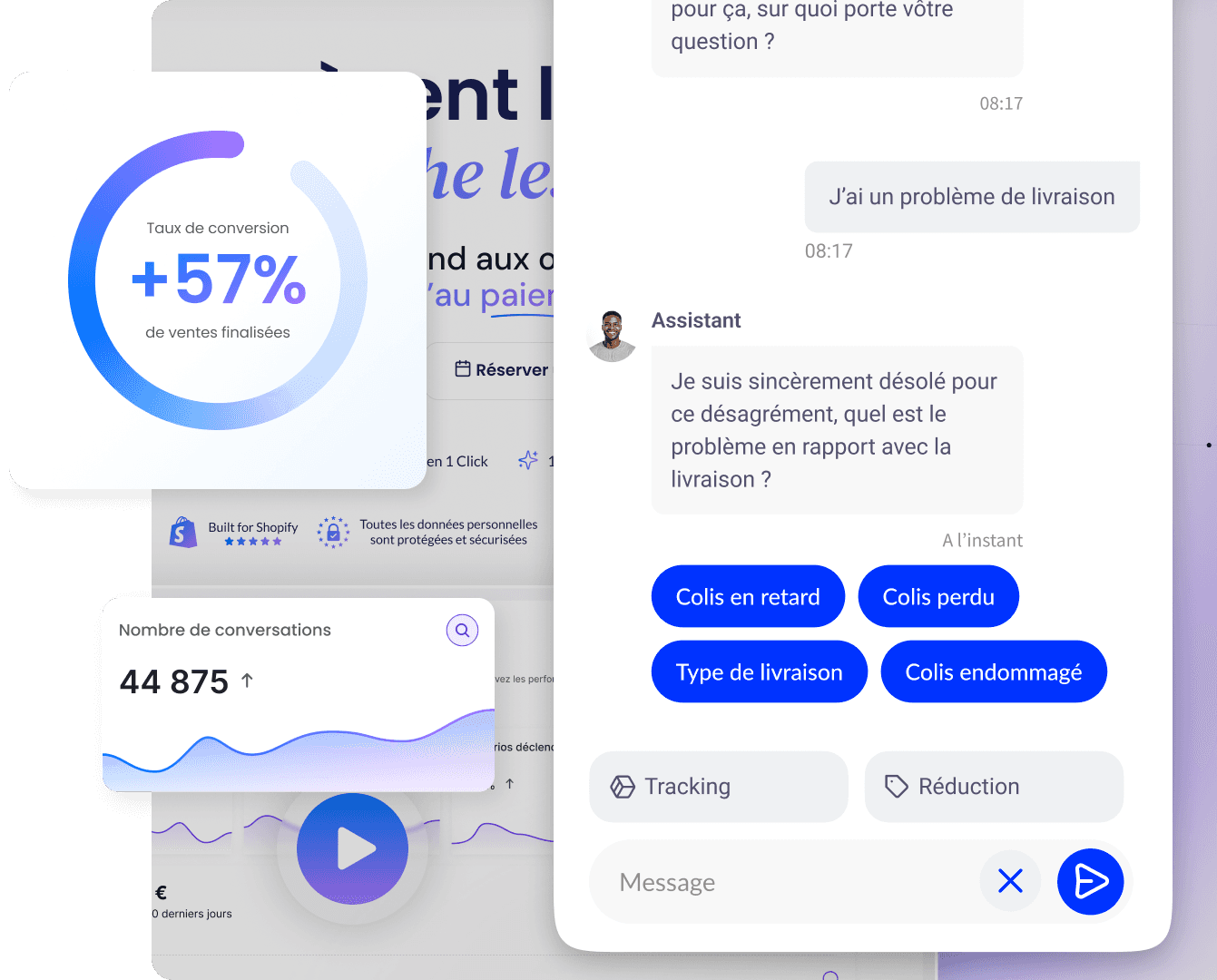
Convert over 2,000 customers on average per month with Qstomy.
The world’s 1st Shopify AI dedicated to customer conversion


Empowering 200+ e-commerce merchants
Why are co-citations crucial for AI?
Artificial intelligences like ChatGPT, Gemini, or Google's AI-generated overviews rely heavily on lists to recommend brands and products. For a query like “best CRM solutions,” AIs often cite multiple sources, and most of them are lists.
These lists do not need to contain links to the brands they mention. Large Language Models (LLMs) analyze co-occurrences—meaning unlinked mentions—to identify relevant players. If your brand does not appear on these lists, it has little chance of being recommended by an AI.
For an e-commerce merchant, this means that your visibility in AI responses depends directly on your presence in external content. The less you are mentioned, the more invisible you become to these tools. It is therefore essential to actively monitor lists and strive to be included in them, as every mention counts toward strengthening your presence in the digital ecosystem.
How do co-citations influence your visibility?
The brands most frequently listed alongside yours define your relevance and visibility. If you regularly appear with recognized players in your industry, search engines and AIs consider you to be part of the same ecosystem.
Conversely, if your brand is absent from lists or cited with irrelevant sites, your credibility may suffer. Co-citations act as a contextualization signal: they help algorithms understand who you are and what you offer.
For e-commerce stores, this means it is essential to appear in the lists that mention your direct competitors. It is an effective way to increase your digital awareness without relying solely on your own content. By analyzing the lists where your competitors are present, you can identify concrete opportunities to improve your visibility and gain credibility in the eyes of AIs.
Co-citation and co-occurrence: what are the differences?
Co-citation refers to a mention with a hyperlink to your website, while co-occurrence is a simple textual mention without a link. Both are important for SEO, but their impact differs.
Co-citations with links are easier to detect and have long been the main signal taken into account by Google. However, with the rise of AI, co-occurrences are gaining importance. LLMs analyze texts as a whole and do not limit themselves to links.
To optimize your strategy, it is therefore crucial to work on both fronts. Getting textual mentions in relevant lists can be just as beneficial as getting backlinks, especially for queries where AI is heavily involved. By combining these two approaches, you maximize your chances of being recommended by search engines and smart assistants.
How to measure your visibility in external listings?
To evaluate your presence in co-citations, start by identifying around twenty lists that mention your competitors. These lists can be blog posts, comparisons, or resource pages.
Next, check whether your brand appears there. You can consult organic search results, sources cited in AI responses like AI Mode or AI Overviews, and references in ChatGPT. Many of these lists overlap, but analyzing them will give you a clear view of your relative visibility.
This analysis will allow you to pinpoint the lists where you are absent and where your competitors are present. These are all opportunities to seize to improve your SEO. By prioritizing the most influential lists, you can focus your efforts on actions that will have the greatest impact on your presence in AI responses.
Which tools can be used to identify co-citation opportunities?
Several tools can help you identify co-citations and monitor your visibility. InTheMix.ai, for example, runs related queries in Gemini, analyzes the responses, and lists the cited sources. This free tool displays the number of responses for each URL, making it possible to identify the most popular sources.
Otterly.ai is another, more comprehensive option that extracts citations for any query from Google AI Overviews, ChatGPT, and Perplexity. It also offers weekly tracking of these citations to discover new opportunities.
Finally, Reddit is a heavily cited source by Google and ChatGPT. Use the Reddit section of AI Brand Rank to analyze your competitors' citations and identify subreddits where your brand and theirs are mentioned together. These tools give you a head start in staying competitive in an AI-dominated environment.
Reddit: a key source for co-citations
Reddit has become an essential source for AI, which frequently uses it to answer user queries. For an e-commerce merchant, this represents a unique opportunity to understand how your brand is perceived and cited.
By analyzing discussions, you can identify subreddits where your brand and your competitors are mentioned in the same threads. These cross-mentions are co-citations that influence your store's visibility in AI responses.
For well-established brands, the AI Brand Rank tool allows for in-depth analysis of these citations. For smaller stores, a manual search on Reddit can already provide valuable insights into the topics and communities to target. By actively participating in these discussions, you can also strengthen your presence and create opportunities for natural co-citations.
How to compare your presence with that of your competitors?
To assess your position, access the main platforms where AIs source their information and compare mentions of your company with those of your competitors. This comparison will give you an overview of your visibility in AI training data.
If your competitors appear in numerous lists and you are absent, it is time to take action. Identify the most influential lists and seek to be included, whether by contacting the authors or improving your content to be more relevant.
This benchmarking is essential for adjusting your SEO strategy and ensuring that your brand is well positioned in AI-generated responses. By regularly monitoring this data, you can anticipate trends and adapt your actions to remain visible in an ever-evolving digital landscape.
How to integrate co-citations into your SEO strategy?
Integrating co-citations into your SEO strategy begins with regular monitoring of lists and articles that mention your competitors. Identify opportunities where your brand could be added, and reach out to the authors to propose your inclusion.
Next, work on your content to make it more likely to be cited. Lists and comparisons are highly favored by AIs, so create this type of content on your own website, as well as resources that others might cite.
Finally, regularly monitor your presence in AI responses. Use tools like Otterly.ai to track your citations and adjust your strategy accordingly. This proactive approach will help you stay visible in an environment increasingly dominated by AI, while strengthening your authority and credibility.
Pitfalls to avoid with co-citations
The first pitfall is neglecting co-occurrences in favor of backlinks alone. With the rise of AI, textual mentions have become just as important, and ignoring this dimension can cause you to miss out on visibility opportunities.
Another pitfall is focusing solely on the most popular lists. AIs use a variety of sources, and small niche lists can be just as influential for your industry. Diversify your targets.
Finally, avoid forcing inclusion into irrelevant lists. Co-citation with brands that have nothing to do with your business can harm your credibility. Prioritize the quality and relevance of sources. Keeping these pitfalls in mind, you can build a solid and sustainable co-citation strategy.
Qstomy: an ally to strengthen your co-citations
Qstomy, the AI agent for Shopify, does not just improve the shopping experience. By guiding your customers to the right products and optimizing their journey, it helps strengthen your store's relevance in the eyes of search engines.
By increasing customer satisfaction and reducing friction, Qstomy encourages positive reviews and mentions of your brand. These trust signals are potential co-citations that can improve your visibility in AI responses.
Additionally, by optimizing your internal search and product recommendations, Qstomy helps you create a consistent experience that encourages customers to talk about you. A well-liked brand is more likely to be cited in lists and comparisons, further strengthening your presence in the digital ecosystem.
Co-citation Checklist and FAQ
Here is a checklist to integrate co-citations into your SEO strategy and improve your visibility in AI responses.
In brief
Identify the lists that mention your competitors.
Analyze your presence in AI responses.
Contact list authors to pitch your brand.
Create listable content on your own website.
Monitor your citations using dedicated tools.
FAQ
Are co-citations more important than backlinks? Both are complementary. Co-citations are gaining importance with AI, but backlinks remain a strong signal for Google.
How many lists should I analyze? About twenty relevant lists are enough to get a clear picture of your relative visibility.
Do co-citations work for small stores? Yes, AIs use a variety of sources, and niche lists can be very influential in your industry.
To go further: How does SEO work for e-commerce sites? - Qstomy, E-commerce SEO strategy for category pages - Qstomy, SEO for e-commerce sites: strategies that really work - Qstomy, Increase sales with intelligent product recommendations - Qstomy, Building your SEO strategy: adapt to succeed - Qstomy, Integrating customer service answers into a customer-useful e-commerce SEO strategy - Qstomy, E-commerce searchandising: optimizing internal search with customer words - Qstomy.

Enzo
October 1, 2026