E-commerce
October 1, 2026
Wondering how generative AI platforms produce their answers? They don't work like a traditional search engine. Understanding this mechanism is essential to adapting your e-commerce strategy and being visible on ChatGPT, Claude, or Gemini.
In concrete terms, these platforms rely on their training data, followed by online searches to construct a response. SEO only influences part of the process, and Google's rules do not apply everywhere. So, how do you stand out?
So how do generative AI platforms generate their answers? On the agenda:
What is the training layer and why is it crucial?
How does AI choose which pages to consult?
Why does the structure of your content influence extraction?
How do you earn a citation in an AI response?
What strategy should you adopt for your Shopify store?
Let's dive in.
Summary
What is the training layer in generative AI?
When a user asks a question to a generative AI platform, it begins by checking whether its training data contains enough information to answer. This first step is called the training layer. If the data is complete, the process stops there, without any online search.
Unlike a search engine, this database does not store URLs and does not rank sources. It contains information from well-known brands with clear value propositions. For an e-commerce merchant, this means that your brand awareness and positioning matter enormously.
If your store is recognized for its expertise, your products, or your guides, the AI can rely directly on this knowledge. It is therefore essential to take care of your brand image and publish useful content, even without the immediate goal of ranking.
Consider creating pages that clearly describe your expertise, your values, and your products. Generative AIs are sensitive to structured and consistent information. A brand that regularly communicates about its area of expertise is more likely to be memorized and used in responses.

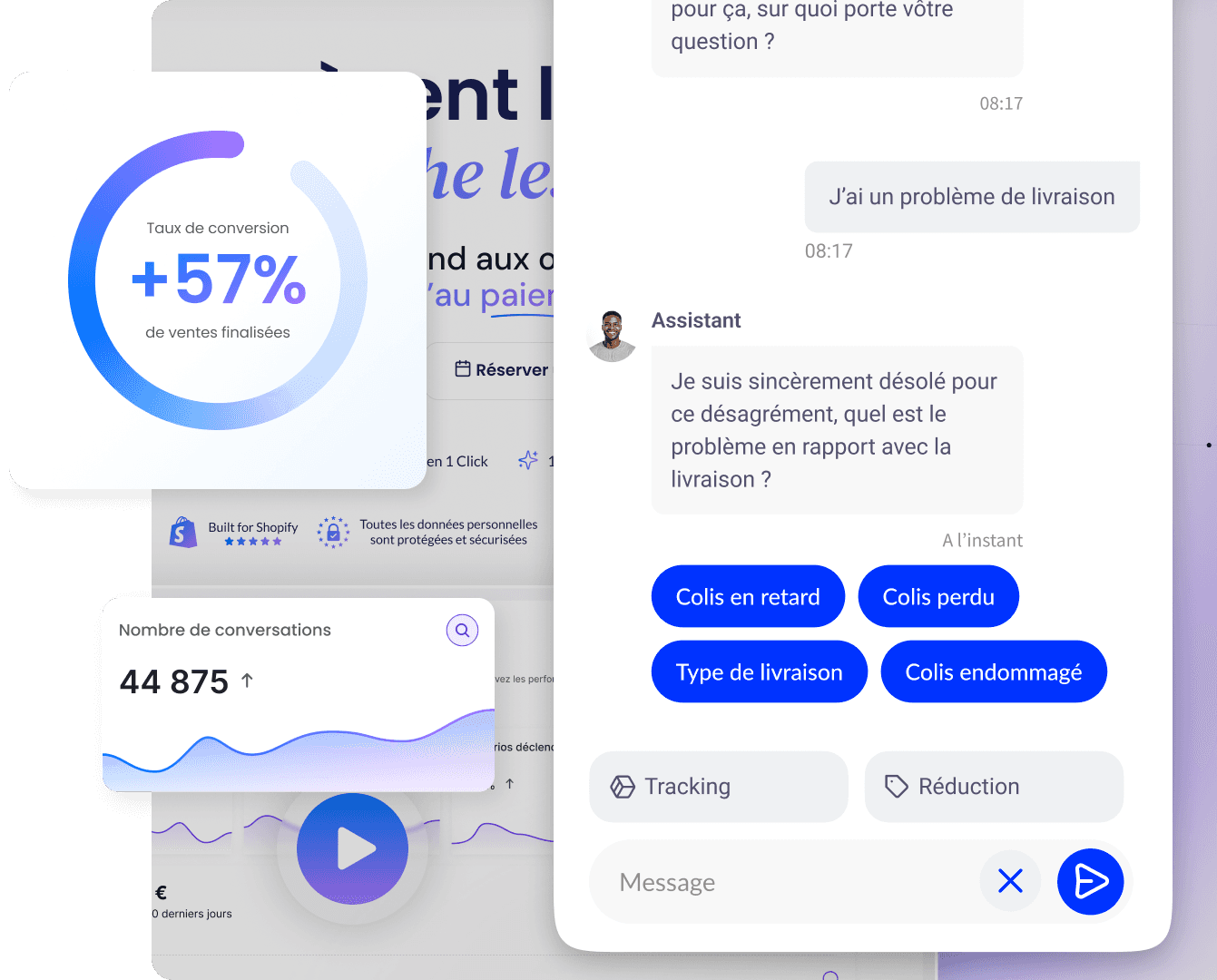
Convert over 2,000 customers on average per month with Qstomy.
The world’s 1st Shopify AI dedicated to customer conversion


Empowering 200+ e-commerce merchants
Why is the training layer crucial for your brand?
The training layer is decisive because it reflects the overall perception of your brand. Generative AIs draw from sources they consider reliable and recognized. If your company is regularly cited in articles, reviews, or guides, it has a higher chance of being included in responses.
For an e-commerce business, this involves a consistent content strategy: detailed product sheets, useful blog posts, and an active presence on social networks. The goal is to become a benchmark in your niche.
Unlike traditional SEO, there are no keywords to target here. It is about building a solid reputation. The more your brand is associated with clear and precise answers, the more naturally the AI will use it.
Don't hesitate to collaborate with influencers or publish case studies. Every mention of your brand in a positive context strengthens your credibility in the eyes of AIs. Consistency is key: a steady stream of quality content is more effective than a one-time effort.
How does generative AI choose which pages to consult?
If the training data is not enough, the generative AI platform queries search engines, just as a human would. This step is called retrieval eligibility. Your site's visibility then depends on your ranking in search results.
No platform officially discloses the search engines it uses. However, independent studies show that Google is predominantly queried. AIs likely rely on top-ranked URLs, even if the selection process is not clearly defined.
For a Shopify merchant, this means that SEO remains an essential lever. If your store does not appear on the first page of Google, it risks never being selected by the AI. It is therefore crucial to work on your organic search ranking in parallel.
Make sure your site is technically optimized: loading speed, meta tags, structured data. A fast and well-indexed site is more likely to be crawled by AI bots. Also consider voice search, which is growing in popularity and influencing queries.
What is the impact of SEO on page retrieval?
SEO has a direct impact on the retrieval stage. If your page is well-ranked, it has a better chance of being found by AI. However, a good ranking does not guarantee that your content will be used. The AI must first determine that your page is relevant to answering the question asked.
It is therefore essential to combine good SEO with quality content. Pages that clearly answer a specific question, with factual and structured information, are favored. Think of your category pages and product sheets as potential answers.
To learn more, check out our guide on how SEO works for e-commerce websites. You will find practical tips there to improve your visibility.
Analyze the questions your customers are asking and create content that answers them directly. Use tools like "People Also Ask" to identify related queries. The more comprehensive and precise your page is, the better its chances of being selected.
How does AI extract information from your pages?
Once the URLs are selected, generative AI can crawl these pages to extract the necessary information. This extraction step is crucial. Clear headings, short and factual sentences, as well as Q&A sections, increase your chances of being included in an answer.
However, this inclusion is only possible if your URL was found and crawled. Having good content is not enough; the AI still needs to discover it. This is why SEO and the structure of your pages are inseparable.
To improve extraction, structure your content with H2 and H3 tags, use bulleted lists, and write short paragraphs. A clear, well-organized page is easier for an AI to understand.
Add FAQs at the bottom of the page, with questions formulated naturally. AIs love Q&A formats because they match the way users ask their questions. This increases the likelihood that your content will be extracted and used.
Why does your content structure influence extraction?
The structure of your content plays a major role in its extraction by generative AIs. Explicit headings, direct answers, and logically organized information help the AI quickly identify relevant elements. A confusing or overly long page risks being ignored.
Adopt a question-and-answer format for your FAQs, use tables to compare products, and write introductions that summarize the essentials. These elements all serve as signals for the AI.
Also consider semantics. Use synonyms and variations of your keywords to cover as many possible wordings as possible. This increases the likelihood that your content matches the user's query.
Avoid unnecessary jargon and favor simple, direct language. AIs are trained on a variety of texts, but they understand clear sentences better. A page that gets straight to the point is more likely to be extracted and cited.
How does citation attribution work in AI responses?
Citation attribution is a mysterious step. Inclusion in a response does not always mean a citation. Studies suggest that citations often stem from the retrieval stage, without the page actually being crawled or used to create the response.
Other hypotheses suggest official partnerships with publishers. Sometimes, certain citations are even hallucinations, meaning URLs that never existed. This lack of transparency makes targeted optimization difficult.
To maximize your chances, focus on what you can control: the quality of your content and your SEO. A well-ranked and well-written page is more likely to be cited, even if the process remains unpredictable.
Follow trends and updates from AI platforms. Some announce partnerships with trusted publishers. If you can become a recognized source in your industry, you increase your chances of being reliably cited.
What is the difference between inclusion and citation in an AI response?
Being included in an AI response means that your content was used to generate the text. Being cited means that your URL is displayed as a source. These two concepts are distinct. A page can be cited without having been used, and vice versa.
For a merchant, a citation is valuable because it brings credibility and can generate traffic. However, inclusion is just as important, as it demonstrates that your content is considered an authority.
The goal is therefore to work on both fronts: quality content for inclusion, and good SEO for citation. It is a comprehensive strategy that requires patience and consistency.
Measure your results by monitoring mentions of your brand in AI responses. Use analytics tools to track traffic coming from these platforms. This will help you adjust your strategy and identify what works.
What strategy should you adopt to be visible on generative AI?
To adapt your strategy, start by building your brand awareness. Publish guides, case studies, and customer reviews. The more visible and recognized your brand is, the more likely it is to be included in AI training data.
Next, work on your SEO to be eligible for retrieval. A good ranking in Google is a prerequisite. Finally, structure your pages to facilitate extraction. Clear headings, direct answers, and logical organization are your allies.
Remember that Google's rules for AI Overviews do not apply to ChatGPT or Claude. Each platform has its own mechanisms. Stay informed and test regularly to see how your content is used.
Create an editorial calendar to regularly publish fresh content. AIs favor up-to-date sources. Update your older articles with new information to maintain their relevance. Consistency is more important than frequency.
Is SEO enough to be visible on generative AI platforms?
SEO influences only two out of four steps in the answer generation process: retrieval and extraction. The training layer depends on your brand awareness, and citation attribution remains largely opaque. It is therefore illusory to think that SEO is enough.
This does not mean that search engine optimization should be abandoned. On the contrary, it is more important than ever. But it must be complemented by a strong brand strategy and impeccable content.
For a complete overview, discover our article on SEO for category pages. You will find tips on structuring your pages and improving their relevance.
Invest in creating quality content, such as in-depth guides or comparisons. These formats are often cited by AIs because they provide added value. Also consider video and infographics, which can be integrated into answers.
How can Qstomy boost your brand awareness and AI visibility?
Qstomy, the Shopify AI agent, helps merchants improve their customer experience, which indirectly strengthens their brand awareness. By guiding visitors toward purchases, offering personalized recommendations, and handling package tracking, Qstomy creates positive interactions.
These interactions generate customer reviews, testimonials, and a solid reputation. A well-liked brand is more likely to be mentioned in articles, blogs, and forums, which increases its presence in AI training data.
Additionally, Qstomy can help reduce returns through smart size guides, as explained in our article on the AI chatbot for size guides. A seamless customer experience is an asset for your brand image.
By improving customer satisfaction, you encourage positive reviews and word-of-mouth. These trust signals are valuable for AIs. A satisfied customer is more likely to recommend your store, strengthening your online presence.
Checklist for optimizing your content for generative AI
Here is a concise checklist to optimize your content:
Brand Awareness: publish guides and case studies to strengthen your brand image.
SEO: work on your Google rankings to be eligible for retrieval.
Structure: use clear headings and direct answers to facilitate extraction.
Customer Experience: offer a smooth user journey to generate positive reviews.
In brief
Generative AI platforms operate in four stages: training, retrieval, extraction, and citation. SEO only impacts two of them. To be visible, combine brand awareness, search engine optimization, and structured content.
FAQ
Do Google's rules apply to ChatGPT? No, Google's guidelines only apply to its own search engine with AI Overviews.
How do I know if my content is being used by an AI? It is difficult to know for sure. Regularly test your queries and observe the answers.
To go further, find out how to train an e-commerce chatbot with Shopify and improve your overall strategy.
To go further: How to optimize an e-commerce site for Google (step-by-step guide) - Qstomy, What e-commerce marketing strategy without an advertising budget? - Qstomy, SEO for e-commerce sites: strategies that really work - Qstomy.

Enzo
October 1, 2026